Aspects of bicycle touring in Japan By Bill Macher
What are Japanese Roads Like?
But even before the roads...how about the drivers? Bicycles
are quite common in Japan and, overall, drivers in Japan are very aware
of bicycles and generally (should I say always ?) understanding of bicyclist's
needs. It is not unusual to find them very willing to wait to pass, and
to treat the bicyclist with "respect" and understanding.
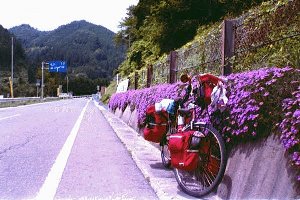 This does not mean that you will get "meters"
(yards) of clearance when you are passed, since the roads themselves may
only be meters wide. Cars in Japan may actually pass closer than cars in
the United States generally do. But the speeds will be lower, and the drivers,
being experienced on the relatively narrow roads, will know where they are,
where you are, and how close they are to you. Overall, being overtaken and
passed in Japan feels safer than it does on American roads. Plus, drivers
expect you to be there...well, perhaps not as a fully-loaded bicycle tourist,
but as a bicyclist...and you will not get any angry yells, smart comments
or horn blowing! So you should be no less safe on Japanese roads than in
other countries (and perhaps safer) as you ride there. The roads in Japan
are relatively well marked with blue signs, at least at major intersections.
Outside of the major cities, these signs will be in Japanese, but should
be recognizable even if you do not read or speak the language. It pays to
have a good map though... especially if you will be travelling smaller secondary
roads. A cheap compass could be helpful (probably in any country) for those
rare times when you lose your bearings and the day is cloudy, with no sun
for reference. This does not mean that you will get "meters"
(yards) of clearance when you are passed, since the roads themselves may
only be meters wide. Cars in Japan may actually pass closer than cars in
the United States generally do. But the speeds will be lower, and the drivers,
being experienced on the relatively narrow roads, will know where they are,
where you are, and how close they are to you. Overall, being overtaken and
passed in Japan feels safer than it does on American roads. Plus, drivers
expect you to be there...well, perhaps not as a fully-loaded bicycle tourist,
but as a bicyclist...and you will not get any angry yells, smart comments
or horn blowing! So you should be no less safe on Japanese roads than in
other countries (and perhaps safer) as you ride there. The roads in Japan
are relatively well marked with blue signs, at least at major intersections.
Outside of the major cities, these signs will be in Japanese, but should
be recognizable even if you do not read or speak the language. It pays to
have a good map though... especially if you will be travelling smaller secondary
roads. A cheap compass could be helpful (probably in any country) for those
rare times when you lose your bearings and the day is cloudy, with no sun
for reference.
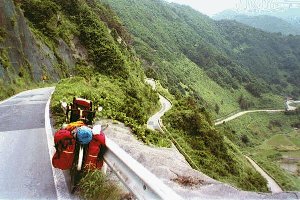 The roads themselves can be quite steep, winding and narrow.
If you cross the mountains you may find yourself on 20 km climbs, with the
road snaking up in a continual series of switchbacks. Going down the other
side may be the same. Often there is no way to maintain speed, as the switchbacks
are sharp, and can be hard to negotiate on a loaded bike at speeds greater
than 10 mph, or maybe less. You may be slowing to reverse direction every
hundred yards or so. A number of times I was glad I had a drag disk brake
on the back of my touring bike, in addition to the normal cantilever brakes. The roads themselves can be quite steep, winding and narrow.
If you cross the mountains you may find yourself on 20 km climbs, with the
road snaking up in a continual series of switchbacks. Going down the other
side may be the same. Often there is no way to maintain speed, as the switchbacks
are sharp, and can be hard to negotiate on a loaded bike at speeds greater
than 10 mph, or maybe less. You may be slowing to reverse direction every
hundred yards or so. A number of times I was glad I had a drag disk brake
on the back of my touring bike, in addition to the normal cantilever brakes.
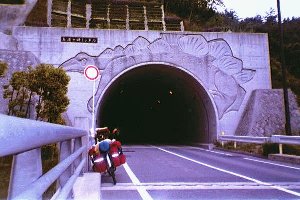 There are lots of tunnels in Japan, as would be expected
of any mountainous country. Some have walkways wide enough to ride on; some
have no walkways at all. Not all are that busy, and it is possible to make
it though even the long ones without being overtaken. One never knows. It
is advisable to take some kind of light, as even though most tunnels have
lights, you will almost certainly find one or two that do not. Some reflective
material on the back is also recommended, and some kind of rear strobe or
tail lamp would not hurt. There are lots of tunnels in Japan, as would be expected
of any mountainous country. Some have walkways wide enough to ride on; some
have no walkways at all. Not all are that busy, and it is possible to make
it though even the long ones without being overtaken. One never knows. It
is advisable to take some kind of light, as even though most tunnels have
lights, you will almost certainly find one or two that do not. Some reflective
material on the back is also recommended, and some kind of rear strobe or
tail lamp would not hurt.
You can also find open drainage ditches at road side and
sometimes the road edge may have a sudden drop off of many feet, with no
guard rail to keep you from falling off! Depends on where you are riding.
I found more of these hazards when traveling south of Tokyo, but that could
be simply due to the roads I chose to ride. I did not find these things
to be too much of a concern, really.
As to gearing, my advice is to gear as low as possible.
It is no fun suffering going up those long climbs, especially if you happen
upon the steeper ones. And there are some long, steep climbs!
I use a 20T granny on the front and a 32 or 34 max on the back. Remember,
you are bicycle touring...and a fully loaded touring bike is not light (mine
weighs in at about 90lb [41 kg] with full water bottles). There is nothing
wrong will enjoying the climbs rather than having to tough it out!
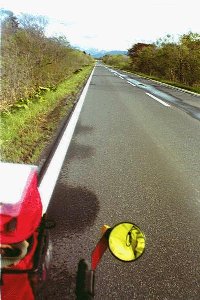 In Japan, you drive on the left, so it might be wise to
adapt or buy a mirror that will work on the right side of your handle bars,
if you use this type of mirror. I found my mirrors invaluable, as they let
me spot large trucks that were overtaking me well in advance, and permitted
me to get off the road onto the the sidewalk if the road was narrow. I did
this more to be nice than out of fear that they would rear end me. An interesting
thing about the larger trucks in Japan, is that they have three green lights
on the top of the cab. These are an indication of the speed the truck is
travelling. All three are on if the the truck is going fast...how fast?
Not sure, perhaps above 5O km or so. (Editor's notes: Above 60 km. But it's not obligated to load these green lights at present.) Anyway, it is very easy to pick up
these lights in the daytime, in your rear view mirror. This view from the
"driver's seat" shows a rural road in Hokkaido...and a right-mounted
mirror, naturally... In Japan, you drive on the left, so it might be wise to
adapt or buy a mirror that will work on the right side of your handle bars,
if you use this type of mirror. I found my mirrors invaluable, as they let
me spot large trucks that were overtaking me well in advance, and permitted
me to get off the road onto the the sidewalk if the road was narrow. I did
this more to be nice than out of fear that they would rear end me. An interesting
thing about the larger trucks in Japan, is that they have three green lights
on the top of the cab. These are an indication of the speed the truck is
travelling. All three are on if the the truck is going fast...how fast?
Not sure, perhaps above 5O km or so. (Editor's notes: Above 60 km. But it's not obligated to load these green lights at present.) Anyway, it is very easy to pick up
these lights in the daytime, in your rear view mirror. This view from the
"driver's seat" shows a rural road in Hokkaido...and a right-mounted
mirror, naturally...
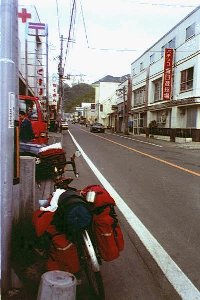 The image to the right is Rausu, in Hokkaido, a small
town on the southern base of the Shiretoko Hanto. Rausu marks the start
of a 16 KM climb over the mountains of the peninsula. This town in many
ways looks like any small Japanese town, at least in sections with fairly
new buildings. But don't worry, there is no end to the traditional side
of Japan, and you will find both old and new intermingled as you ride. The image to the right is Rausu, in Hokkaido, a small
town on the southern base of the Shiretoko Hanto. Rausu marks the start
of a 16 KM climb over the mountains of the peninsula. This town in many
ways looks like any small Japanese town, at least in sections with fairly
new buildings. But don't worry, there is no end to the traditional side
of Japan, and you will find both old and new intermingled as you ride.
If you take this road, note that just over 2 miles up there
is a camp ground on the right, and almost directly across from the campground
entrance is a nice, free outdoor onsen bath. Stop and enjoy a wonderful
bathing experience, for sure! I did not stay at this or any other campgrounds
in Japan, but I understand this one is not expensive...Had I reached this
Rausu later in the day, I most likely would have stayed there and enjoyed
several soaks in the nice free outdoor onsen.
uploaded:16, 11, 2006
|

 First step
 Area Guide